


A perfect glass of juice is the result of the perfect combination of mechanical precision operation and material science. In commercial kitchens or food processing plants, when a screw juicer rotates slowly but fails to produce the expected juice, it not only leads to a waste of costs but also a decline in production efficiency. The level of juice yield directly affects the economic benefits and product competitiveness of an enterprise. This article will delve into the key factors influencing the juice yield of screw juicers, covering everything from mechanical principles to material properties, to help you comprehensively optimize the juicing process.

01 The mechanical principle of the screw juicerr
To understand why a juicer doesn’t produce juice, it is first necessary to understand its working principle. As an efficient pressing device, the core principle of the screw juicer is to use the mechanical squeezing effect of the screw shaft to separate the juice from fruits and vegetables. The core working process is as follows: The power section inputs power, transmits the extrusion torque, and drives the entire extrusion screw roller to rotate. Raw materials are continuously fed into the hopper and pushed to the left under the action of the screw roller.
During this process, the cross-sectional area continuously decreases to achieve extrusion. The residue gradually separates from the juice, and finally the residue is discharged at the left end of the extrusion cylinder, while the juice flows out along the surface of the extrusion cylinder. The reason why the screw juicer is suitable for a variety of fruits and vegetables such as tomatoes, pineapples, carrots, apples, aloe vera and cacti is that this progressive squeezing method can adjust the squeezing force according to the characteristics of different materials to maximize the extraction of juice.
02 Adjust the gap to balance the juice yield and juice quality
The screw juicer controls the resistance to residue discharge and the juice extraction efficiency through the annular gap formed between the screw and the conical part for pressure regulation. When the handwheel bearing housing is turned clockwise, the pressure regulating head moves to the left and the gap decreases. Conversely, the gap becomes larger. This adjustment essentially alters the residue rate, which in turn affects the juice extraction effect. When the gap is too small, under strong squeezing, some of the residue particles will be squeezed out along with the juice through the filter screen, resulting in an increase in juice output but a decline in juice quality. Conversely, if the gap is too large, it will result in insufficient juice extraction and overly wet residue.
How to find this balance point? The wise approach is: when starting the equipment, the pressure head should be adjusted first to maximize the annular gap, then gradually reduce the gap. After meeting the process requirements, the position of the handwheel bearing housing should be fixed with the brake. For some high-end models, a more precise extrusion cylinder follow-up control system is adopted. Through springs and hydraulic cylinders, the lateral relative position of the extrusion cylinder and the extrusion screw roller can be adjusted in a timely manner during the juice extraction process according to different raw materials and different residue rates. This enables the equipment to precisely control the slag discharge rate and the squeezing force, thereby enhancing work efficiency.


03 The characteristics of the materials determine the juice extraction efficiency
The characteristics of the materials have an impact on the juice yield no less than that of mechanical factors. Only by understanding the physical properties of the materials can the equipment parameters be adjusted in a targeted manner to maximize the juice extraction efficiency.
The viscosity and solid content of the material are the key factors affecting the juice output. Single-screw press is suitable for solid-liquid separation operations of materials containing a small amount of fiber or being sticky, such as tofu residue, mulberries, crushed aloe vera, kitchen waste, wine residue, vinegar residue, fermented apples and pears, and other materials with a small amount of fiber for juice extraction.
For high-viscosity materials such as mangoes and bananas, greater extrusion force and longer extrusion time are required. For low-viscosity materials such as watermelon and oranges, the squeezing force needs to be controlled to avoid excessive squeezing causing the juice to become cloudy.
The fiber content and structure of the material directly affect the ease of juice release. High-fiber materials such as celery and aloe vera require greater squeezing force and special spiral designs to ensure that the fibers are fully squeezed.
The maturity of the materials and the pretreatment methods will also affect the juice yield. Although overly ripe fruits are rich in juice, their flesh is often too soft, resulting in poor pulp removal during the squeezing process. Unripe fruits, on the other hand, have a low juice yield because their cell walls have not been fully softened.
04 The dual influence of temperature on juice yield
In the process of juicing, temperature control is an easily overlooked but crucial factor. Appropriate temperature management can significantly increase the juice yield and maintain the quality of the juice.
Hot pressing is a process that increases the juice yield by heating the material to destroy the cell structure and reduce the viscosity of the juice. This method is applicable to fruits with high pectin content such as apples and pears, and can significantly increase the juice yield. However, hot pressing also has obvious drawbacks: high temperatures can lead to the loss of volatile flavor substances and may produce a cooked taste.
Cold pressing is carried out at room temperature or low temperature, which can better preserve the natural flavor, color and heat-sensitive nutrients of fruits. Technical research in 2025 indicates that an optimized low-speed extrusion design can keep the temperature rise of juice within 5.2℃ and significantly increase the retention rate of vitamin C.

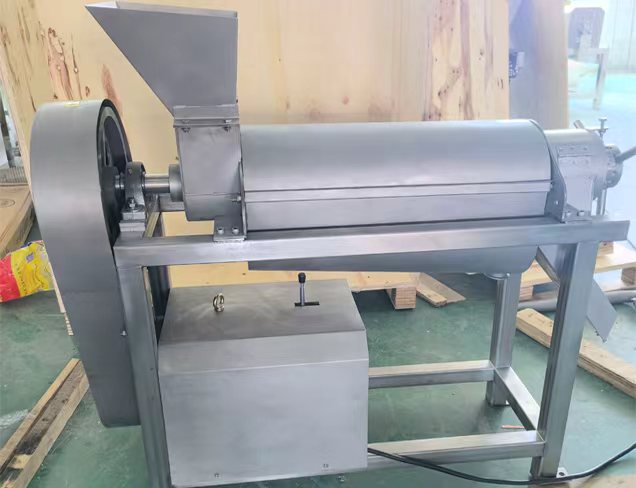
Commercial Screw Juice Machine
Back to our initial question – why doesn’t your juicer produce juice? The answer may lie in whether the setting of the pressure regulating gap is appropriate, whether the screw design matches the characteristics of the material, or whether the suitable juicing temperature has been selected. Just as Commercial Screw Juice Machine achieves a balance between juice yield and quality through an automatic feeding system and an optimized slow extrusion technology, modern juicing technology is seeking the best balance between mechanical precision and material science.